How to Invoice as a Freelancer: Rates, Payment Terms, and Examples
Freelancer invoicing explained with hourly and fixed-price examples, deposits, revisions, international clients, and payment follow-up.
Agree on scope before you invoice
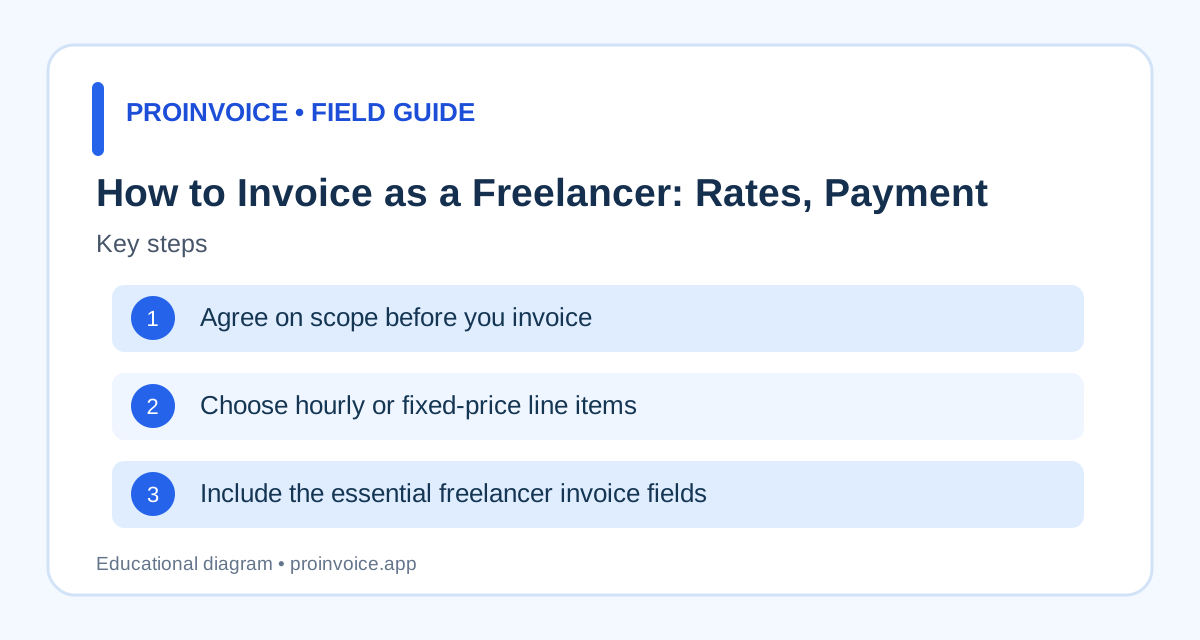
Freelancers are often hired through email, chat, or a short proposal, which can leave billing expectations unclear. Before work begins, confirm the client, deliverables, price, revision limits, timeline, and payment schedule in writing. Identify whether the fee is fixed, hourly, or tied to milestones. If you charge a deposit, explain when it is due and how it will be credited. A clear agreement helps prevent a customer from interpreting extra revisions as included work. For longer projects, document how changes will be approved and priced. The invoice should reflect the agreement rather than introducing new terms after delivery. Review the estimate versus invoice guide to understand when to propose a price and when to request payment.
Choose hourly or fixed-price line items
For hourly billing, describe the service, billing period, hours, and agreed rate. Eight consulting hours at $90 per hour equal $720. For a fixed-price project, identify the completed deliverable and contract amount instead of inventing hours. A graphic designer might bill an approved logo package for $850, while a writer might bill a defined article package. If you invoice multiple milestones, label each one so the client knows what has been completed and what remains. Keep time logs or delivery records when the agreement requires them. Do not mix rates or charge unapproved additional work without explanation. The consulting invoice template and graphic design invoice template illustrate different approaches.
Include the essential freelancer invoice fields
Add your business or professional name, contact details, the client's correct billing entity, invoice number, issue date, due date, and itemized work. State the currency and remaining balance clearly. For international clients, confirm which currency the contract uses and who bears conversion or transfer charges. If your client needs a purchase order or tax documentation, resolve those requirements before the invoice is due. Include relevant project or contract references. Tax requirements vary by jurisdiction and business status, so do not copy another freelancer's tax treatment blindly. A unique invoice number makes it easier to reconcile payments and answer questions. A polished invoice helps, but correct details and agreed terms matter more than decorative design.
Handle deposits and milestone payments
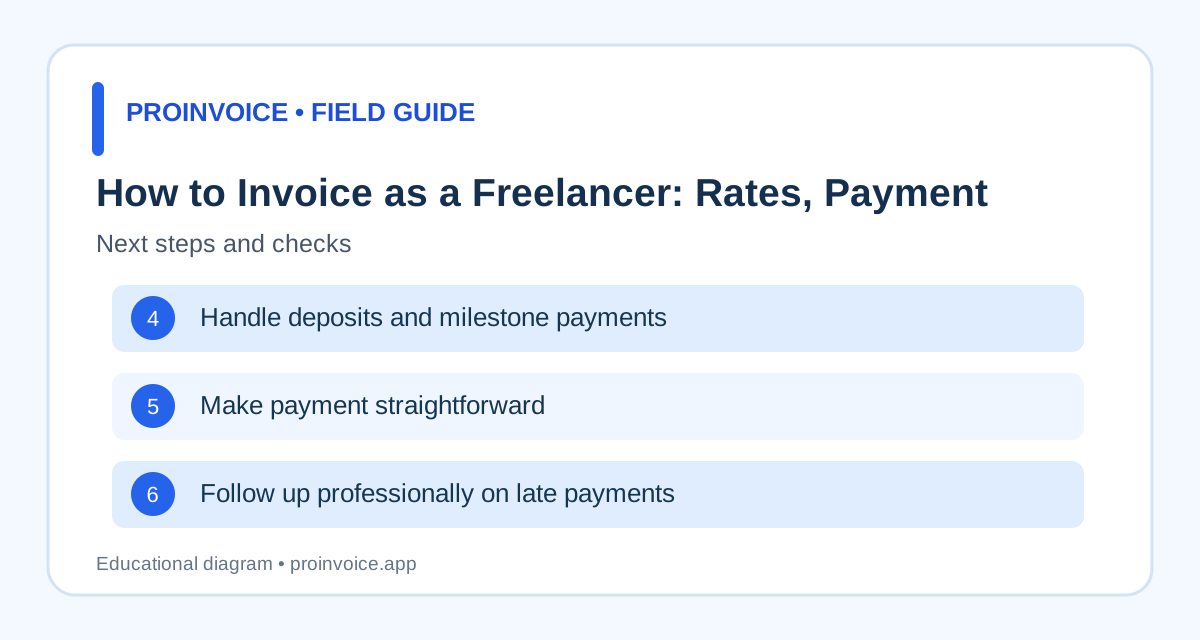
A deposit can reduce the amount of unpaid work at risk, but it must be tracked accurately. Suppose a $1,600 website design project requires an agreed $400 deposit and a $1,200 completion payment. The final invoice should show the correct remaining balance, not ask for $1,600 again. If the client approves an additional $200 deliverable, document the change and update the total to $1,800, leaving $1,400 after the deposit. These numbers are examples, not standard freelancer rates. Make sure the contract describes what happens if a project is canceled or paused. Deposit rules and enforceability vary, so seek local advice when needed. Review deposit collection for workflow considerations.
Make payment straightforward
Use a specific due date and accepted payment methods. A client should not have to ask how to pay after receiving the invoice. If you offer online checkout, confirm the payment link shows the correct amount and merchant identity. Processing fees, settlement times, and available methods vary by provider and account. Do not assume international transfers settle instantly. For corporate clients, ask whether the invoice must be submitted to a vendor portal. Keep bank instructions secure and verify unexpected changes through a trusted channel. If the client pays a partial amount, update the balance before sending reminders. The payment links guide covers practical setup issues for supported ProInvoice payment workflows.
Follow up professionally on late payments
If payment is late, first confirm the invoice was received and the balance is correct. A short reminder should identify the invoice number, amount, due date, and payment method. Ask whether the client needs another copy or disputes a charge. If the client says payment was sent, reconcile the transaction before escalating. Avoid threatening fees or legal consequences that are not authorized. For clients with recurring delays, consider clearer deposits or milestone schedules on future projects. Keep communication factual and preserve the agreement, delivered work, and invoice history. The unpaid invoice guide explains a measured escalation process. Protecting the relationship matters, but so does maintaining clear expectations.
Build a repeatable freelancer workflow
Save a template that reflects your services, but review the customer, invoice number, amount, and dates every time. Keep the estimate, accepted scope, revision approvals, invoices, and receipts attached to the same project. For repeat clients, confirm billing contacts periodically. Track outstanding invoices and cash flow rather than treating every sent invoice as money already earned in the bank. When work grows, consider whether dedicated software reduces duplicate entry and missed follow-up. Explore invoice templates, ProInvoice features, and get started to evaluate a consistent workflow. A good system is one that lets you explain every charge and every payment.
How to invoice international clients
International work adds questions about currency, payment methods, exchange rates, and cross-border fees. Agree on the invoice currency before starting work, rather than choosing it after the project is finished. Confirm whether the client expects to pay in their local currency or yours and how conversion charges will be handled. Payment methods available in one country may not be available in another. Check provider documentation for your specific merchant account and customer location. Tax documentation and invoice requirements may also vary, so seek jurisdiction-specific advice where necessary. Make the billing entity and contact information precise, particularly when a client operates through several subsidiaries. If a transfer takes longer than expected, check its status before treating the customer as late. Keep the gross invoice amount, processing costs, and converted bank deposit distinguishable in your records.
Invoice retainers and recurring work accurately
A retainer may cover a defined period, a set number of hours, or access to your services under a contract. Describe what the fee covers and when it becomes payable. If unused hours roll forward or extra work is billed separately, make that arrangement clear before issuing invoices. For example, a monthly $1,200 design retainer may include agreed support services, while an additional approved campaign is billed as a separate line item. Avoid describing all recurring charges as subscriptions when the contract is actually for professional services. Include the service month or billing period so the client can distinguish consecutive invoices. Review the agreement when rates or scope change. A repeatable invoice template reduces administrative work, but it cannot replace a clear written understanding of what the retainer includes.
Manage revisions and scope changes
Creative projects frequently expand after the original brief. A client may request another design direction, more editing rounds, or new deliverables. Before billing extra work, explain why the request is outside the agreed scope and obtain approval for the additional price or hours. Keep the approval with the project record. On the invoice, reference the approved change rather than using an unexplained extra services line. If the work is disputed, compare the accepted scope with the delivered files and written requests. Avoid using the invoice as the first notice that the project price increased. A simple change log containing the request, date, price, and approval can prevent disputes. For milestone projects, update the remaining schedule if the new work affects delivery or payment dates.
Handle client expenses and reimbursements
Freelancers sometimes pay for travel, stock assets, software licenses, or subcontractors on a client's behalf. Determine in advance which expenses are reimbursable and whether approval is required. Keep receipts and distinguish reimbursed expenses from your service fee on the invoice. For example, an agreed $900 consulting fee and an approved $85 travel expense may be shown as separate lines so the client can verify both amounts. Do not assume that every expense is tax-free or that all clients will accept undocumented charges. If the client pays vendors directly, do not bill those expenses again. Clarify whether any markup is permitted. Proper documentation matters because reimbursement rules, taxes, and accounting treatment depend on the arrangement and jurisdiction.
A practical month-end freelancer routine
At the end of each billing period, review completed work, approved milestones, tracked hours, and any expenses. Match them against the contract before drafting invoices. Confirm the billing contact and purchase order references for each client. Check that deposits and previous payments are credited correctly. Send invoices through the required channel and record the delivery date. Reconcile incoming payments against invoice numbers rather than guessing from bank deposit amounts. Follow up on overdue balances with factual reminders and document any disputes. Review outstanding receivables before taking on additional work for a chronically late-paying customer. This routine is useful even with only a few clients because it reduces missed billing and gives you a clearer view of cash expected in the coming weeks.
Invoice a client who pays in stages
A freelancer may receive a booking deposit, a midpoint payment, and a final payment. For a $3,000 project with three agreed $1,000 stages, each invoice should clearly identify the stage being billed and whether the payment has already been received. Avoid asking for the entire contract amount each time. Keep the original scope and any approved additions in one project record. If the client pays the second stage early, update the balance before sending the next invoice. A customer should be able to reconcile all stage invoices with the contract without guessing. If the project is canceled, consult the agreed cancellation and refund terms rather than automatically treating every unpaid milestone as due. Clear stage billing can protect both cash flow and the working relationship.
Explain payment terms to a new client
Do not assume a new client understands labels such as Net 15, due on receipt, or milestone billing. State an actual due date and explain what event triggers each payment. For corporate customers, ask about vendor onboarding and purchase order requirements before sending the first invoice. For individuals, provide clear instructions and an accessible payment method. Discuss deposits and late-payment policies before the work begins. If a customer asks for a longer payment period, agree on it explicitly rather than silently changing the due date after sending the invoice. The purpose of terms is to remove ambiguity, not to intimidate the client. Put the same terms in the agreement and invoice so the documents do not conflict.
Keep freelancer records organized for tax season
Store issued invoices, receipts, refunds, and related expenses in a consistent system. Distinguish money invoiced from money actually received, especially when payments cross calendar periods. Keep processor fees and currency conversion separate from gross customer payments for reconciliation. The appropriate tax treatment depends on your jurisdiction and accounting method, so do not treat this guide as tax advice. Track reimbursable expenses with supporting receipts and avoid mixing personal purchases with client costs. When a customer disputes a charge, preserve the agreement and delivery records. A monthly review is easier than reconstructing a year of transactions from scattered emails. Reliable invoice records also help you evaluate which clients and services are most profitable.
How to explain invoice questions without escalating
When a client asks why an invoice is higher than expected, compare the line items with the accepted scope and any approved additions. Answer with dates, deliverables, and written approvals rather than a defensive message. If you made a mistake, correct it promptly and provide an updated balance. If the client misunderstood the agreement, point to the relevant term and invite a specific question. Avoid threatening collection action while the amount is genuinely being reviewed. Keep a record of the discussion and any agreed adjustment. Clear, factual communication protects your reputation and makes future work more predictable.