How to Write a Professional Estimate: Pricing Checklist and Example
Build a clear service estimate with scope, labor, materials, exclusions, contingencies, customer approval, and change-order handling.
Start with the job and the customer
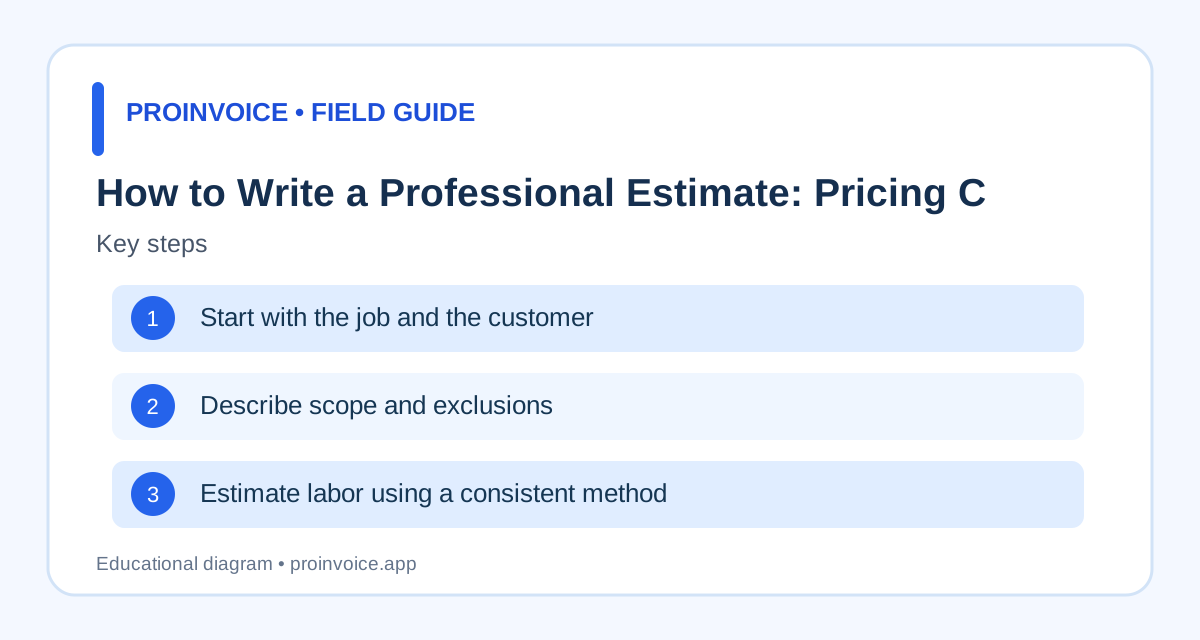
An estimate is a proposal for work, not proof that the customer owes money. Record the customer's billing identity, service location, estimate number, preparation date, and contact details. Visit the job site or gather reliable measurements and specifications when necessary. Ask what outcome the customer expects, which materials or standards apply, and what work is outside the requested scope. If important conditions are hidden or unknown, state that limitation. A good estimate is specific enough for the customer to understand what is included and for your team to deliver it. Avoid a one-line description for a complex project. Start with an estimate template suited to your trade.
Describe scope and exclusions
List the deliverables, quantities, materials, and relevant assumptions. For a room-painting estimate, identify preparation, number of coats, surfaces, and whether trim or ceilings are included. For an HVAC job, identify the equipment and installation scope. State meaningful exclusions such as concealed damage, permits not included, or customer-supplied materials. Exclusions should clarify the agreement, not hide essential work the customer reasonably expects. If the scope depends on an inspection, explain what may require a revised estimate. Avoid vague phrases like complete renovation when the actual work covers only a few specified tasks. The construction estimate template and HVAC estimate template show why scope detail differs by project.
Estimate labor using a consistent method
Calculate the work hours or crew days needed, then apply a rate that reflects the business's costs and pricing strategy. For example, two technicians working six hours each represent twelve labor hours. At an illustrative billing rate of $85 per hour, labor would be $1,020. That rate is an example, not a market benchmark. Consider travel, setup, cleanup, supervision, and difficult access where relevant. Do not confuse an employee's wage with the full cost of delivering the service. If the customer is purchasing a fixed-price deliverable, you can calculate labor internally while presenting the agreed project price externally. Review past jobs to compare estimates with actual time. Consistency improves future pricing decisions even when each job is different.
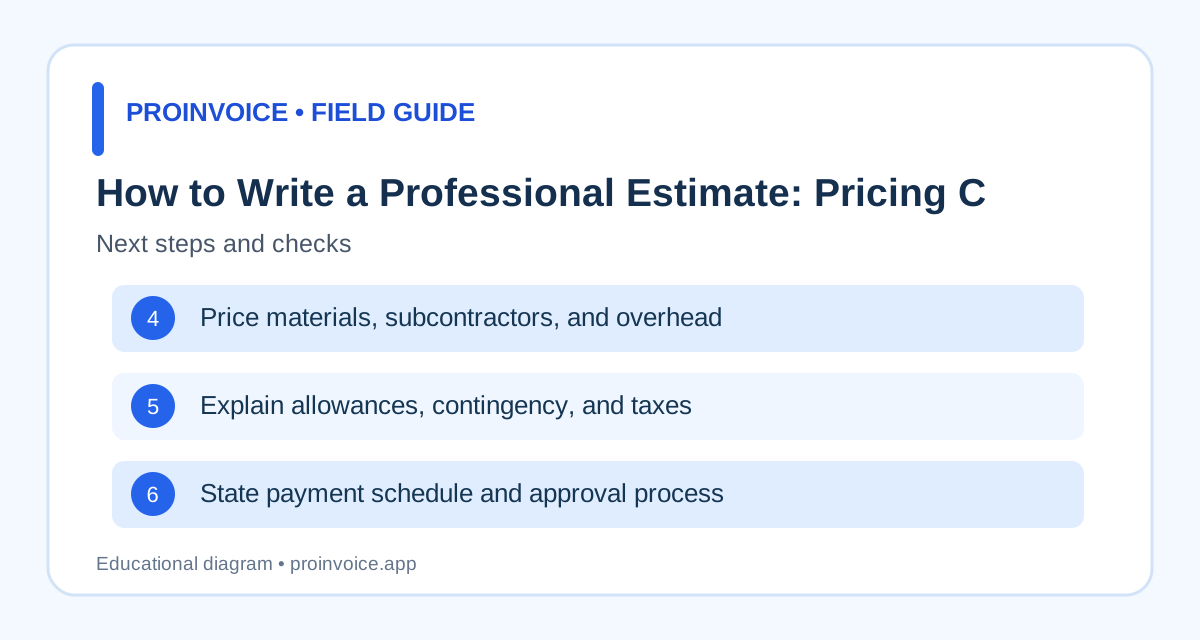
Price materials, subcontractors, and overhead
List expected materials with quantities and current costs, then account for waste, delivery, and any agreed markup where appropriate. Include subcontractor quotes, equipment rental, disposal, permits, and other project-specific expenses. Avoid assuming every cost can be added to a fixed-price contract after acceptance. Overhead and profit should be considered when setting the quoted price, even if they are not displayed as separate line items. For example, an estimate with $1,020 labor and $680 materials has a $1,700 direct-cost subtotal before other costs and the business's pricing adjustments. That number is not necessarily the final customer price. If material availability is uncertain, state quote validity and how substitutions are approved. Keep supporting calculations for internal review.
Explain allowances, contingency, and taxes
An allowance is a budgeted amount for an item not yet selected; it is not the same as a guaranteed final cost. Explain how a customer's choice above or below the allowance affects the price. A contingency may help plan for uncertainty, but whether it is included in the customer price or held internally should be explicit. Avoid adding arbitrary contingency charges after acceptance without contractual support. Tax rules vary by location and type of work, so verify which items are taxable rather than applying one universal rate. Identify whether the estimate includes tax, delivery, and disposal. If permits or inspections are necessary, say who is responsible. Customers should be able to compare proposals without discovering important omissions after the job starts.
State payment schedule and approval process
An estimate should say how and when the customer accepts it, when work can begin, and what payment events apply. If a deposit is requested, state the amount and how it will be credited against the contract. Residential construction deposit limits vary by jurisdiction, so check local rules. For long projects, describe milestones or progress billing rather than assuming the full price is due immediately. Include an expiration date when pricing depends on changing material costs. Explain how additional work will be approved and priced. Keep the accepted version and any subsequent change orders together. The deposit guide and change order guide help organize the next steps.
Example: a small service estimate
Suppose a landscaping job includes six labor hours at $80, $240 in plants, and $90 in approved disposal charges. The illustrative subtotal is $810 before taxes or other adjustments. The estimate should identify the property, planting area, plant specifications, cleanup expectations, and any exclusions. If the customer requests additional irrigation repair, document that as a separate proposed change rather than silently increasing the final bill. Once the customer approves the estimate, perform the work according to the agreement and issue an invoice when the billing trigger occurs. The landscaping estimate template is a relevant starting point. An accurate estimate is a shared plan for the job, not merely a number at the bottom of a page.
Estimate versus quote versus invoice
An estimate commonly describes an anticipated price based on current information and assumptions. A quote may represent a more definite offer under specified terms, although terminology and legal consequences vary. An invoice requests payment for an amount due under the agreement. Do not treat these labels as interchangeable or assume the word estimate eliminates all contractual obligations. Explain which document the customer is receiving and what acceptance means. For uncertain work, state the assumptions and how changes will be approved. For fixed-price jobs, identify the deliverables and exclusions carefully. When the customer accepts, retain the accepted version and issue invoices only according to the payment schedule. A clear document trail protects both parties and makes later questions about price easier to resolve.
How to estimate when the scope is uncertain
Some jobs involve hidden conditions that cannot be assessed until work begins. Plumbing repairs may reveal corroded pipes, while renovation work may expose damaged framing. Describe what is known, what is assumed, and which discoveries could require a revised scope. Where appropriate, separate diagnostic work from the proposed repair. Do not promise a fixed total for unknown work unless you are prepared to honor the agreed risk allocation. Explain how the customer will be notified and asked to approve changes before additional work proceeds. An allowance can cover an undecided selection, but it should not disguise an unknown labor requirement. Keep photographs, measurements, and notes where permitted and useful. Transparent uncertainty is more credible than an unrealistically precise number that cannot be supported.
Compare estimated margin with actual costs
An estimate should support a sustainable business, not just win the job. After completion, compare planned labor hours, material quantities, subcontractor charges, and other costs against what actually happened. If you estimated ten labor hours but used sixteen, identify whether the cause was poor measurement, travel, difficult access, or a scope change. Track repeated differences by job type so future estimates improve. Do not assume revenue minus materials equals profit; labor burden, insurance, overhead, equipment, and other costs may matter. A contractor can maintain an internal costing worksheet while presenting a simpler customer-facing estimate. Review profitability without hiding errors from the customer. The purpose is to improve future pricing and execution, not retroactively charge customers for ordinary estimating mistakes without contractual authority.
Present options without confusing the customer
Some customers benefit from a good-better-best proposal, but options should have clearly different scopes rather than vague quality labels. For example, a landscaping estimate might offer basic cleanup, cleanup plus planting, and a broader package including irrigation improvements. List what each option includes and excludes, and show its price separately. Avoid summing mutually exclusive options into one total. If the customer selects one option, record the accepted version and use it as the basis for the work order and later invoice. Where materials vary by brand or specification, describe those differences in plain language. A comparison can improve understanding, but too many overlapping options make approval harder. Keep the final acceptance unambiguous.
Review the estimate before customer approval
Check customer identity, property address, measurements, quantities, unit costs, scope, exclusions, taxes, permit responsibilities, validity period, and payment schedule. Confirm that the document does not promise work your team cannot deliver or omit work the customer reasonably expects. If a deposit is included, verify that it complies with applicable rules. Ask a second person to review complex estimates where practical. Preview the document on mobile and as a printable copy. When the customer requests changes, update the estimate and keep the earlier version rather than relying on verbal memory. After approval, record the accepted scope and avoid making silent changes. A disciplined final review is one of the simplest ways to reduce disputes and preserve margin.
Write an estimate customers can compare
Customers often request several bids and need to understand why prices differ. Use a consistent structure: scope, materials, labor or project price, assumptions, exclusions, schedule, and payment terms. Avoid presenting a low headline total while omitting disposal, permits, or necessary preparation that another bidder includes. If your proposal offers options, show each option separately so totals are not confused. Explain differences in material specifications or service levels in ordinary language. A transparent estimate can compete on quality and clarity without pretending every job should be the cheapest. Customers should be able to identify exactly what they would receive and which circumstances might change the price. Good documentation also makes the accepted estimate easier to convert into an accurate invoice.
Build a repeatable estimating checklist by trade
Different trades need different inputs. Painters may need surface area, preparation, access, and number of coats. Landscapers may need site dimensions, plant quantities, irrigation scope, and disposal. Plumbers may need fixture details, accessibility, and diagnostic assumptions. Consultants may need deliverables, hours, and review cycles. Create a checklist for the jobs you regularly perform, then update it when actual costs reveal missed steps. Do not rely on a generic template to identify every trade-specific risk. A checklist improves consistency while leaving room for job-specific notes. Keep supporting measurements and customer approvals with the estimate so that a later invoice can reference the correct scope. The goal is a reliable price proposal that your team can deliver.
Respond when the customer wants a lower price
When a customer asks for a discount, review scope and costs before changing the total. You may be able to offer a smaller package, different materials, or a revised schedule without sacrificing necessary quality. Describe what is removed or changed, and obtain approval of the revised estimate. Avoid simply reducing the total while leaving the original deliverables unchanged if the job would become unprofitable. Do not pressure customers with unsupported claims about scarcity or guaranteed savings. If the customer has another bid, ask whether the scopes are comparable. A professional response explains the trade-offs and preserves the integrity of the agreement. If the customer declines, keep the estimate and correspondence for your records rather than treating the unaccepted proposal as an invoice.
What to do after an estimate is accepted
Save the accepted estimate and confirm the start date, scope, materials, responsibilities, and payment schedule. Make sure the person approving the work has authority to do so. If conditions change before work begins, discuss the implications rather than quietly altering the price. During the project, record customer-approved changes separately. When an agreed billing milestone occurs, issue an invoice referencing the accepted work and apply any deposit credit. Keep receipts and project records organized. The estimate is the foundation for delivery and billing, not a document to forget after the customer says yes.